
Boulder, CO 80302, United States, 7th Sep 2026 – SayMorph, the browser-based tone and style rewriting tool operated at saymorph.com, has outlined the fact-preservation standard that governs how it rewrites text. SayMorph is owned and operated by NexaPioneer, a software studio that builds AI-powered web products and publishes each product under its own brand and domain. The standard holds that a rewrite may change register, phrasing, sentence order and length, but must leave the factual content of the source text intact. The rule has been set out in response to a pattern observed across automated writing tools, in which rewriting features alter the substance of a message while adjusting its delivery.
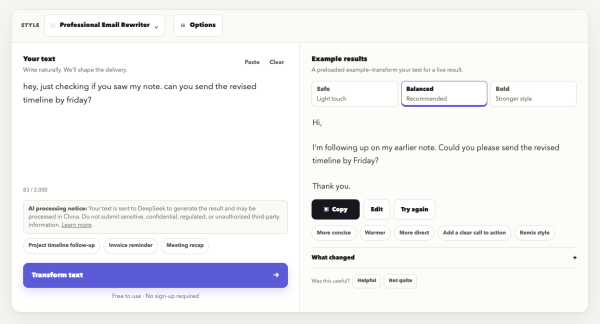
The distinction drawn by the standard is between how something is said and what has been said. Under the rule, figures, dates, names, deadlines, conditional statements and negations carry through a rewrite unchanged. A sentence declining a request remains a refusal after being made more diplomatic. A qualified estimate remains qualified after being made more concise. Content absent from the source is not added, and commitments that were never made are not implied.
SayMorph operates as a free browser-based tool at saymorph.com and carries more than 500 transformation options. These cover registers such as formal, casual, diplomatic, concise, technical and empathetic, alongside conversions between long-form and short-form text. The tool is applied most often to workplace correspondence, customer support replies and social posts, where the same information frequently has to be delivered differently depending on audience and channel.
The underlying difficulty is a familiar one in office settings. A message written quickly for a colleague can read as blunt once forwarded to a client. A support reply written under time pressure can read as dismissive. Rewriting by hand takes time, and rewriting through general-purpose generative tools often produces text that is smoother but no longer accurate, with unstated assurances or invented detail introduced along the way.
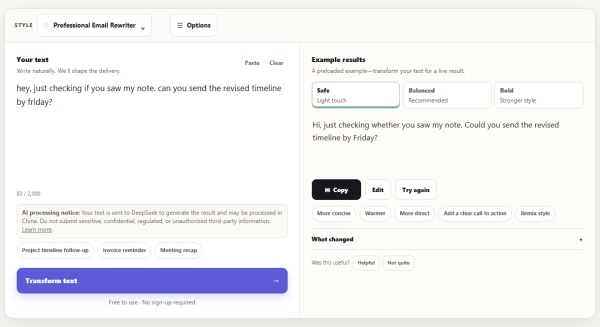
“The distinction that matters is between how something is said and what is actually being said,” said Jack Shi, Founder of NexaPioneer, the company that owns and operates SayMorph. “A rewrite that softens a refusal until it reads as an approval has not adjusted tone, it has altered the record. The standard exists so that the output can be trusted at the level of substance and not only at the level of wording.”
The standard also addresses voice. Rewrites are constrained so that identifiable characteristics of the source text, including vocabulary preference and sentence rhythm, are retained where the requested register allows. The constraint is applied to reduce the flattening effect commonly associated with automated rewriting, in which text from different authors converges on a single generic style. Retaining those characteristics matters most in correspondence sent under an individual name, where recipients are familiar with how the sender ordinarily writes.
Fact preservation operates as a standing constraint across the full set of transformation options rather than a setting applied to selected ones. A conversion into a formal register is held to the same requirement as a conversion into a casual one, and shortening a passage is treated as subject to the same limits as expanding it. Compression is identified as the point of highest risk, since removing words can strip the qualifier that made a statement accurate. Under the standard, a qualifier is retained even where the requested output length would otherwise favour cutting it.
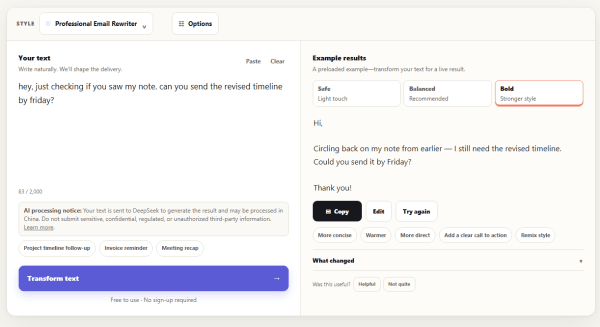
Use of the tool spans professionals, creators, students and technical practitioners across English-speaking markets. In regulated and technical settings, the verification burden attached to automated text has been cited as a reason such tools are set aside, since checking a rewritten passage line by line can take longer than composing the passage manually. A constrained rewrite narrows the range of what requires checking, because the elements most likely to carry consequences are held fixed by the process itself.
“Work is continuing on clearer signposting of what a rewrite has altered, so that the difference between source and output stays visible to the person sending the message,” said Shi. “The intention is that the reasoning behind an output remains available for inspection rather than sitting hidden behind it, which is the condition under which a tool of this kind becomes usable in settings that carry consequence.”
SayMorph is a browser-based tone and style rewriting tool, available without charge at saymorph.com and used by professionals, creators, students and technical practitioners. SayMorph is owned and operated by NexaPioneer, a software studio based in Boulder, Colorado, that designs and builds AI-powered web products for global English-speaking markets. NexaPioneer publishes each of its products under its own brand and domain, and retains ownership and operation of each. The fact-preservation standard applies to all transformation options within SayMorph and forms part of the assessment criteria for further transformation tools added to the platform.
For additional information about SayMorph and its AI tone rewriter capabilities and related industry developments, contact NexaPioneer at 1942 Broadway, Ste 314C, Boulder, CO 80302, United States. Inquiries regarding the company’s products, transformation tools, documentation and formula references can be directed by email to jack@nexapioneer.com.
Media Contact
Organization: NexaPioneer – SayMorph
Contact Person: Jack Shi
Website: https://nexapioneer.com/
Email: Send Email
Address:1942 Broadway
Address 2: Ste 314C
City: Boulder
State: CO 80302
Country:United States
Release id:48620
The post NexaPioneer Product SayMorph Sets a Fact Preservation Standard for AI Tone Rewriting appeared first on King Newswire. This content is provided by a third-party source.. King Newswire makes no warranties or representations in connection with it. King Newswire is a press release distribution agency and does not endorse or verify the claims made in this release. If you have any complaints or copyright concerns related to this article, please contact the company listed in the ‘Media Contact’ section
The information contained in this post is for general information purposes only. The information is provided by NexaPioneer Product SayMorph Sets a Fact Preservation Standard for AI Tone Rewriting and while we endeavour to keep the information up to date and correct, we make no representations or warranties of any kind, express or implied, about the completeness, accuracy, reliability, suitability or availability with respect to the website or the information, products, services, or related graphics contained on the post for any purpose.